Prismatic Chromatic Refraction & High-Order Dispersion Dynamics
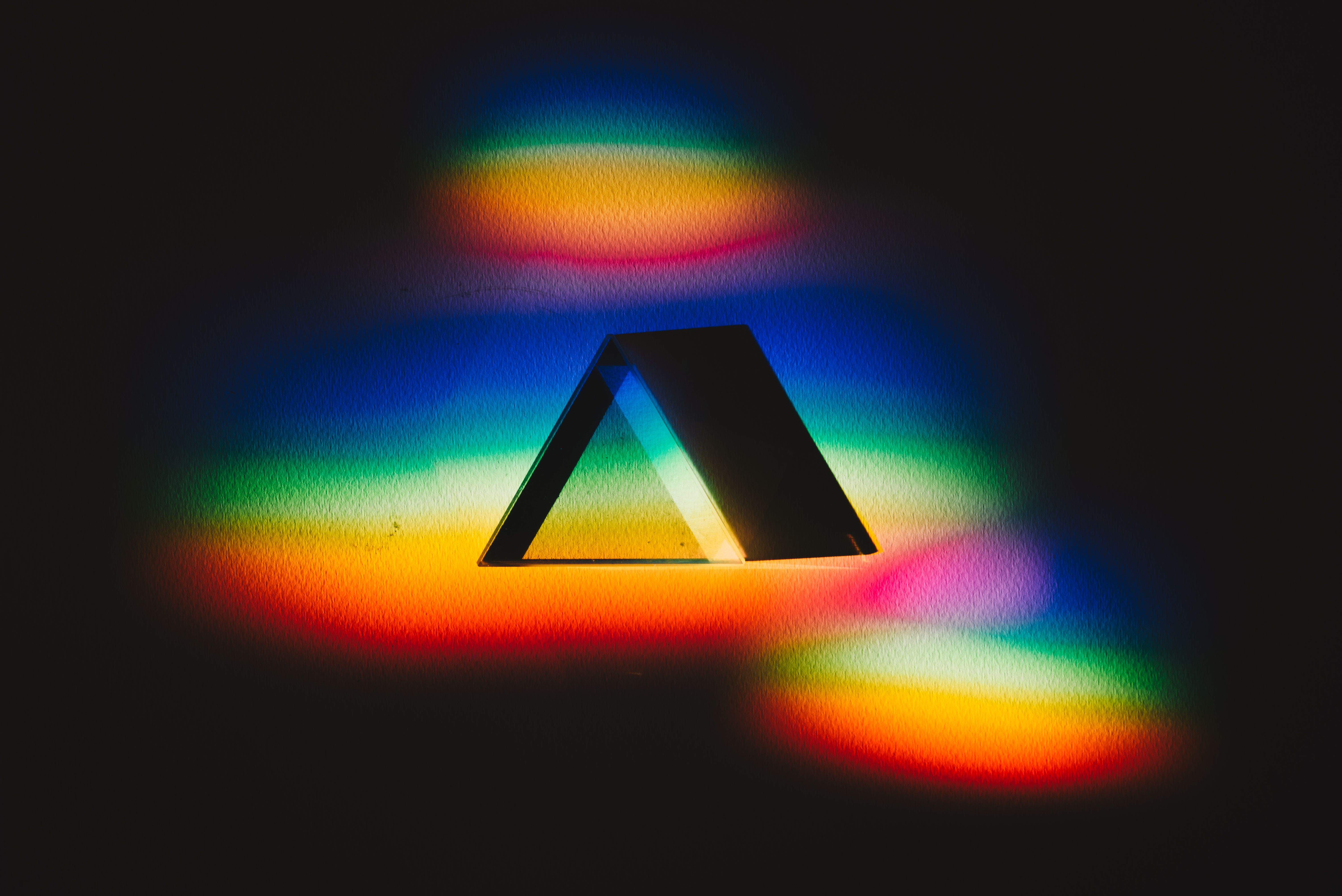
Prismatic optical conduits are fundamental instruments in spectroscopy, ultrafast pulse compression, and optical wavelength division. When polychromatic illumination traverses a dispersive glass prism, the optical phase velocity varies as a function of frequency due to electron resonance interactions within the atomic lattice. This wavelength dependence triggers chromatic spatial angular separation, decomposing unpolarized light into its fundamental spectral components. In high-power ultrafast laser engineering, prismatic pairs provide controllable negative group delay dispersion (GDD) to compensate for positive material chirp accumulated across extended glass paths.
This technical publication presents a rigorous mathematical and physical analysis of chromatic refraction through dielectric prism geometries. We derive the empirical Sellmeier dispersion equation, quantify angular dispersion and minimum deviation geometry, formulate higher-order Taylor expansion dispersion terms ($\beta_2, \beta_3, \beta_4$), and provide a production-grade C++ numerical simulation engine for modeling pulse compression and spectral chirping in ultrafast optical systems.
1. Sellmeier Resonance Physics & Angular Refraction Dynamics
The wavelength-dependent refractive index $n(\lambda)$ of optical glass in transparent regions far from fundamental electronic absorption bands (UV) and lattice vibration bands (IR) is accurately modeled by the empirical Sellmeier Equation:
$$n^2(\lambda) = 1 + \sum_{i=1}^{3} \frac{B_i \lambda^2}{\lambda^2 - C_i}$$
Where $B_1, B_2, B_3$ are phenomenological oscillator strengths and $C_1, C_2, C_3$ represent resonance absorption wavelengths squared. For a light ray entering an isosceles prism with apex angle $\alpha$ at incidence angle $\theta_1$, the total angular deviation $\delta(\lambda)$ following two successive refractions is formulated as:
$$\delta(\lambda) = \theta_1 + \arcsin\left( \sin\alpha \sqrt{n^2(\lambda) - \sin^2\theta_1} - \cos\alpha \sin\theta_1 \right) - \alpha$$
The minimum angular deviation $\delta_{\text{min}}$ occurs when the internal optical ray passes symmetrically through the prism parallel to its base ($\theta_1 = \theta_2$). Under minimum deviation symmetry, the material refractive index $n(\lambda)$ is directly determined via the precise geometric relation:
$$n(\lambda) = \frac{\sin\left(\frac{\alpha + \delta_{\text{min}}(\lambda)}{2}\right)}{\sin\left(\frac{\alpha}{2}\right)}$$
Differentiating the deviation equation with respect to wavelength yields the angular dispersion rate $\frac{d\delta}{d\lambda}$, which dictates spatial spectral resolution in optical monochromator setups:
$$\frac{d\delta}{d\lambda} = \frac{\sin\alpha}{\cos\theta_2' \cos\theta_2} \cdot \frac{dn}{d\lambda}$$
2. Empirical Optical Glass Dispersion Parameters & Material Metrics
Selecting appropriate optical glass substrates for prismatic conduits requires balancing raw refractive index magnitude against dispersion slope and Abbe number $V_d = \frac{n_d - 1}{n_F - n_C}$. Below is an empirical dataset cataloging Sellmeier coefficients, group velocity dispersion (GVD), and third-order dispersion (TOD) metrics at $1064\text{ nm}$ and $1550\text{ nm}$ across industry-standard optical glasses:
| Glass Type | Refractive Index $n_d$ (587.6nm) | Abbe Number $V_d$ | Sellmeier $B_1$ | GVD $\beta_2$ @ 1064nm ($\text{fs}^2/\text{mm}$) | TOD $\beta_3$ @ 1064nm ($\text{fs}^3/\text{mm}$) |
|---|---|---|---|---|---|
| N-BK7 (Borosilicate Crown) | 1.5168 | 64.17 | 1.03961212 | 18.45 | 34.20 |
| Fused Silica ($SiO_2$) | 1.4585 | 67.82 | 0.69616630 | 15.82 | 27.60 |
| SF11 (Dense Flint) | 1.7847 | 25.76 | 1.73759695 | 142.10 | 168.50 |
| F_Lak28 (Lanthanum Crown) | 1.7130 | 53.83 | 1.51230000 | 42.30 | 58.10 |
| CaF2 (Calcium Fluoride) | 1.4338 | 95.23 | 0.56758880 | 8.95 | 14.10 |
Dense flint glasses such as SF11 exhibit exceptionally high group velocity dispersion ($\beta_2 \approx 142.10 \text{ fs}^2/\text{mm}$), making them ideal for compact prism pulse compressor configurations where small physical path lengths generate massive negative angular GDD.
3. Higher-Order Taylor Phase Dispersion & C++ Simulation Engine
When an ultra-short optical pulse traverses a dispersive material, its spectral phase $\phi(\omega)$ can be expanded as a Taylor series centered around the carrier frequency $\omega_0$:
$$\phi(\omega) = \phi(\omega_0) + \phi'(\omega_0)(\omega - \omega_0) + \frac{1}{2} \phi''(\omega_0)(\omega - \omega_0)^2 + \frac{1}{6} \phi'''(\omega_0)(\omega - \omega_0)^3 + \dots$$
Where $\phi''(\omega_0) = \text{GDD} = \beta_2 L$ induces linear frequency chirp, and $\phi'''(\omega_0) = \text{TOD} = \beta_3 L$ introduces asymmetric temporal pulse distortion (forming satellite prepulses). The following C++ production-grade simulation engine models Gaussian pulse propagation through dispersive optical glass, calculating temporal pulse broadening and spectral phase evolution:
#include#include #include #include #include using namespace std; typedef complex dcomp; // Glass Material Properties Structure struct GlassDispersionConfig { string glass_name; double thickness_mm; double B1, B2, B3; double C1, C2, C3; }; // Calculates Refractive Index via Sellmeier Equation double calculate_sellmeier_index(const GlassDispersionConfig& g, double lambda_um) { double l2 = lambda_um * lambda_um; double n2 = 1.0 + (g.B1 * l2)/(l2 - g.C1) + (g.B2 * l2)/(l2 - g.C2) + (g.B3 * l2)/(l2 - g.C3); return sqrt(n2); } // Numerical Derivative for GVD (beta2) in fs^2/mm double calculate_beta2(const GlassDispersionConfig& g, double lambda_um) { double dlambda = 0.0001; // 0.1 nm delta for numerical differentiation double c = 299.792458; // speed of light in um/ps double n_mid = calculate_sellmeier_index(g, lambda_um); double n_plus = calculate_sellmeier_index(g, lambda_um + dlambda); double n_minus = calculate_sellmeier_index(g, lambda_um - dlambda); // Second derivative d2n/dlambda2 double d2n_dlambda2 = (n_plus - 2.0 * n_mid + n_minus) / (dlambda * dlambda); // beta2 = (lambda^3 / (2 * pi * c^2)) * (d2n / dlambda2) double beta2_ps2_um = (pow(lambda_um, 3) / (2.0 * M_PI * c * c)) * d2n_dlambda2; return beta2_ps2_um * 1.0e6; // Convert to fs^2/mm } // Simulates Gaussian Pulse Broadening through Glass Span void simulate_pulse_propagation(double tau_in_fs, double beta2_fs2_mm, double length_mm) { // Initial pulse width T0 = tau / (2 * sqrt(ln(2))) double T0 = tau_in_fs / 1.66511; // Total GDD = beta2 * L double GDD = beta2_fs2_mm * length_mm; // Output pulse duration tau_out = tau_in * sqrt(1 + (GDD / T0^2)^2) double tau_out_fs = tau_in_fs * sqrt(1.0 + pow(GDD / (T0 * T0), 2)); cout << fixed << setprecision(2); cout << "===== DISPERSION PROPAGATION SIMULATION =====" << endl; cout << "Input Pulse Width (FWHM): " << tau_in_fs << " fs" << endl; cout << "Glass Thickness: " << length_mm << " mm" << endl; cout << "Accumulated GDD: " << GDD << " fs^2" << endl; cout << "Output Pulse Width (FWHM): " << tau_out_fs << " fs" << endl; cout << "Broadening Factor: " << (tau_out_fs / tau_in_fs) << "x" << endl; } int main() { // N-BK7 Sellmeier Constants GlassDispersionConfig nbk7 = { "N-BK7", 50.0, // 50mm glass path 1.03961212, 0.231792344, 1.01046945, 0.00600069867, 0.0200179144, 103.560653 }; double lambda_center = 1.064; // 1064 nm Nd:YAG laser double beta2 = calculate_beta2(nbk7, lambda_center); cout << "Calculated N-BK7 GVD @ 1064nm: " << beta2 << " fs^2/mm" << endl; simulate_pulse_propagation(30.0, beta2, nbk7.thickness_mm); // 30 fs input pulse return 0; }
4. Engineering Calibration & Optical Alignment Protocols
Deploying prismatic optical channels in precision spectroscopy requires systematic calibration to eliminate spatial beam astigmatism and beam pointing drift. Below are field engineering procedures for optimizing prism alignment:
Brewster Angle Incidence & Reflection Loss Mitigation
Symptom: Excessive Fresnel reflection loss exceeding $15\%$ at prism input interfaces, causing severe throughput attenuation.
Diagnostic Root Cause: Optical beam polarization vector oriented perpendicular (S-polarized) to the plane of incidence, or entrance angle deviating from Brewster's angle $\theta_B = \arctan(n)$.
Remediation Protocol: Rotate input optical polarization to pure P-polarization using a zero-order half-wave plate. Adjust entrance angle to strictly satisfy Brewster's condition, reducing surface Fresnel reflection to $<0.1\%$ without requiring anti-reflective coatings.
Spatial Chirp & Beam Transverse Astigmatism
Symptom: Elliptical beam spatial distortion accompanied by transverse spatial wavelength segregation at the focus of downstream imaging lenses.
Diagnostic Root Cause: Single-prism refraction inducing angular dispersion without secondary complementary spatial recombining.
Remediation Protocol: Implement a double-prism sequence in antiparallel orientation. Ensure equal glass insertion depths across both prisms to cancel residual spatial chirp while preserving net group delay dispersion adjustment.
"Precision control of chromatic refraction requires a rigorous balance between material resonance physics, precise geometric Brewster alignment, and higher-order spectral phase management."
5. Architectural Summary & Advanced Ultrafast Roadmap
Prismatic optical conduits remain vital components in high-precision photonics. By combining geometric refraction with tailored glass chemistry, engineers can manipulate the spectral and temporal properties of light with extraordinary accuracy.
Future research in our optical labs focuses on integrating programmable liquid-crystal spatial light modulators (SLM) within 4f prismatic zero-dispersion pulse shapers, enabling arbitrary spectral phase and amplitude synthesis for quantum control experiments.